How Map Rotation Impacts Meta in Marvel Rivals
Marvel Rivals is an exciting competitive game where players take on the roles of heroes. It combines strategic thinking with fast-paced action. In this game, players fight in various landscapes, each requiring different strategies to win. The competitive scene of the game relies heavily on adaptability, as teams strive to improve their mechanical skills and come up with innovative tactics.
At the core of Marvel Rivals' strategy lies map rotation. Each battleground presents its own set of challenges:
Vertical combat zones require teams to gain control of elevated positions
Narrow corridors lead to intense battles fought up close
Open areas reward players who position themselves well and engage from a distance
To succeed in Marvel Rivals, it is crucial to understand how these dynamics specific to each map work. Teams must adjust their choice of heroes and tactics to align with the requirements of the current rotation. A strategy that works well in the confined spaces of Hell's Heaven may not be effective in the vastness of Yggdrasil Path.
The connection between map design and overall strategy creates a constantly changing competitive environment. Players who become skilled at navigating this relationship will have a significant advantage as they strive for higher ranks.
The Role of Map Rotation in Competitive Matches
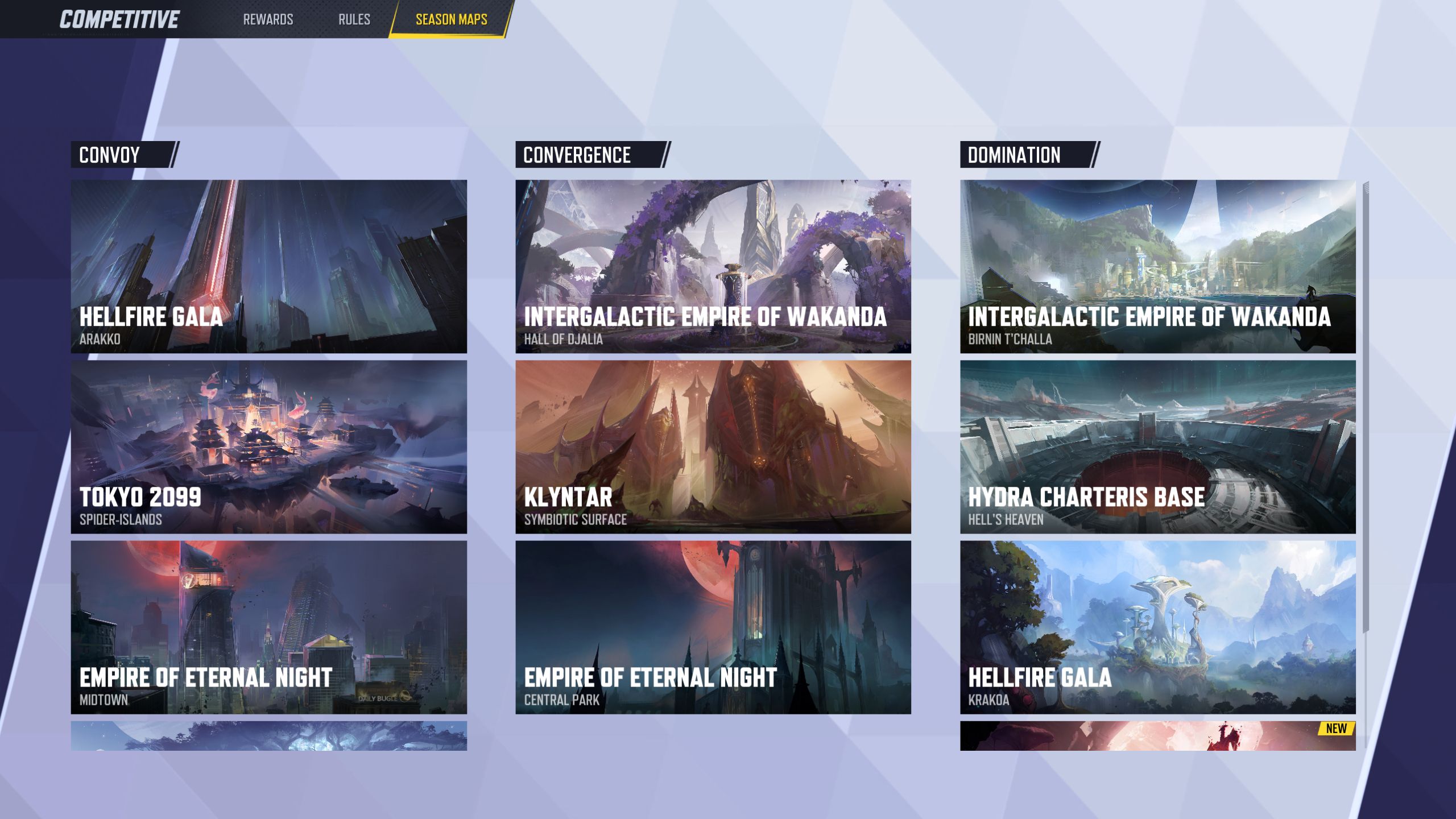
Season 2 introduced a structured map rotation system that transformed competitive gameplay in Marvel Rivals. This system cycles through diverse environments, each demanding unique tactical approaches and team compositions.
Key Maps in Current Rotation
Convoy Maps
Midtown (Empire of Eternal Night) - Features urban battlefield environments with multiple elevation levels.
Spider-Islands (Tokyo 2099) - High-tech futuristic setting with dynamic terrain features.
Yggdrasill Path (Yggsgard) - Mystical Asgardian-themed map with Norse mythology elements.
Convoy mode requires teams to escort a moving payload through multiple checkpoints.
Convergence Maps
Hall of Djalia (Intergalactic Empire of Wakanda) - Advanced Wakandan technology setting.
Symbiotic Surface (Klyntar) - Symbiote-themed alien world environment.
Convergence mode combines capture and escort objectives in hybrid gameplay.
Domination Maps
Birnin T'Challa (Intergalactic Empire of Wakanda) - Features three control points: Warrior Falls, Stellar Spaceport, and Imperial Institute of Science.
Hell's Heaven (Hydra Charteris Base) - Military facility with Eldritch Monument, Frozen Airfield, and Super-Soldier Factory areas
Krakoa (Hellfire Gala) - Mutant paradise setting added in Season 2, featuring Cradle, Carousel, and The Grove control points
Celestial Husk (Klyntar) - The newest addition launched July 11, 2025, featuring dark symbiote themes and ancient Celestial remains
The rotation system creates a constantly evolving competitive landscape. Teams must adapt their strategies as maps shift from open battlegrounds to confined spaces, from vertical playgrounds to horizontal battlefields. This variety prevents the meta from becoming stagnant and rewards versatile players who can excel across different environmental challenges.
Map rotations spark strategic innovation in the competitive scene. Teams develop specialized tactics for each environment while maintaining flexibility to adjust their approach mid-match. The system pushes players to expand their hero pools and master multiple playstyles, elevating the skill ceiling of competitive play.
Interestingly, this concept of map rotation isn't exclusive to Marvel Rivals. It mirrors certain aspects of competitive first-person shooter games where procedurally generated maps are rarely utilized due to various factors, including design complexity and player adaptation challenges. Understanding these dynamics can provide valuable insights into the broader landscape of competitive gaming beyond just Marvel Rivals.
Influencing Meta Strategy Through Map Features
Map features shape the competitive landscape in Marvel Rivals, creating distinct advantages for specific heroes and team compositions. Each map's unique design elements demand different strategic approaches and hero selections.
Terrain Layout and Verticality
High ground control stands as a decisive factor in maps like Tokyo 2099 and Hall of Djalia. These vertical battlegrounds reward heroes with:
Wall-climbing abilities (Spider-Man)
Teleportation skills (Magik)
Aerial combat specialties (Storm)
Teams controlling elevated positions gain critical advantages:
Enhanced sight lines for ranged attacks
Better escape routes during team fights
Strategic dropping points for surprise engagements
Space Constraints and Chokepoints
Tight spaces in Klyntar and Hell's Heaven create intense close-quarter combat scenarios. These confined areas affect gameplay through:
Chokepoint Control
Area denial abilities become powerful tools
Heroes with crowd control excel at zone defense
Team fights concentrate around narrow passages
Hero Effectiveness
Winter Soldier's grenades block pathways
Hulk's body blocking potential increases
Doctor Strange's barriers gain extra value
Magik's close-range combat skills become invaluable
Scarlet Witch's chaos magic can manipulate the battlefield to her advantage
Open Spaces and Mobility
Maps like Yggdrasil Path showcase the strength of mobile heroes and long-range specialists. Open terrain characteristics include:
Tactical Advantages
Multiple flanking routes
Extended line of sight for snipers
Freedom of movement for chase-downs
Optimal Hero Types
Hela's ranged attacks find full value
Iron Man's flight capabilities shine
Black Widow's grappling hook enables quick repositioning
Luna Snow's ice-based powers provide both offense and defense in open spaces
Invisible Woman's invisibility can be strategically utilized in wide-open areas for surprise attacks or escapes.
These map features create micro-metas within the broader game strategy, and teams must adapt their hero pools and tactical approaches based on each map's dominant
Adapting Hero Picks to Map Rotation
Success in Marvel Rivals demands smart hero selection based on map-specific advantages. Each map's unique layout creates opportunities for specific hero abilities to shine:
Tokyo 2099 Specialists
Psylocke - Unmatched vertical mobility and aerial combat prowess
Spider-Man - Web-swinging mechanics for rapid high ground control
Storm - Aerial superiority and map-wide presence
Yggdrasil Path Champions
Hela - Excels in open spaces with ranged attacks
Iron Man - Long-range engagement and quick repositioning
Captain Marvel - High mobility and area control abilities
Klyntar Combat Experts
Winter Soldier - Tight corridor control and ambush potential
Black Widow - Stealth advantages in confined spaces
Venom - Wall-climbing and close-quarters dominance
A diverse hero pool becomes essential as maps rotate. Players who master 3-4 heroes across different playstyles gain significant advantages:
Tank Role - Mix between shield-based (Captain America) and mobility tanks (Hulk)
Damage Dealers - Balance between close-range (Wolverine) and ranged specialists (Hawkeye)
Support Heroes - Alternate between defensive (Vision) and offensive supports (Magik)
Team composition flexibility allows quick adaptation to map changes. A balanced hero roster helps maintain a competitive edge through map rotations while preventing over-reliance on specific strategies that might prove ineffective on certain layouts.
Strategic Team Play Based on Map Characteristics
Successful team coordination in Marvel Rivals demands precise positioning and area control strategies tailored to each map's unique layout. Teams must establish clear roles and responsibilities for securing vital zones, often utilizing team-ups to unlock unique abilities that enhance their strategic advantage.
High Ground Control
Position ranged damage dealers like Storm on elevated platforms
Station defensive heroes such as Magneto to protect access points
Rotate support heroes between multiple vantage points
Chokepoint Management
Place area-denial abilities at narrow passages
Set up crossfire positions for maximum damage output
Use tank heroes to create space for team advancement
Resource Zone Security
Split team into mobile strike groups
Maintain line-of-sight coverage between separated units
Establish fall-back positions near objective points
Map-specific defensive setups require careful consideration of team composition and positioning. On Tokyo 2099, teams often create multi-level defense networks using heroes with vertical mobility like Storm. Klyntar's confined spaces call for tight-knit formations with heroes who excel at close-quarter combat.
Making combat layout adjustments based on map characteristics is crucial for success. Attack strategies shift based on map architecture:
Open Maps: Wide flanking maneuvers with mobile heroes
Vertical Maps: Coordinated dive attacks from multiple elevations
Enclosed Maps: Methodical push-and-hold tactics through corridors
Teams must practice rapid repositioning between defensive and offensive formations. This flexibility allows quick responses to enemy movements while maintaining control over critical map sections. Effective teams coordinate ultimate abilities to create space for objective captures or to defend against concentrated enemy pushes.
The Competitive Impact of Season 3's Map Rotation System
Season 3's formalized map rotation system has transformed competitive play in Marvel Rivals. The structured rotation schedule has pushed teams to develop broader strategic depths and adapt their hero pools.
Shift in Competitive Meta
The competitive meta has shifted from specialized team compositions to versatile lineups capable of performing across different map types. Teams now prioritize:
Hero Flexibility - Players who can switch between multiple heroes like Winter Soldier, Squirrel Girl, or Hawkeye have become invaluable
Balanced Rosters - Organizations recruit players with complementary hero pools
Adaptive Playstyles - Teams master multiple strategies rather than perfecting a single approach
Impact on Tournament Preparation
The new system has also impacted tournament preparation. Professional teams now dedicate practice time to:
Map-specific strategies for the entire rotation pool
Counter-picks based on map features
Role-swapping scenarios between players
Rise of Versatile Teams
The competitive scene has seen the rise of teams with deep hero pools and strategic versatility. Single-strategy specialists struggle to maintain consistent performance across the rotation. This system rewards teams that embrace adaptability and master the nuances of each battleground.
Conclusion
Map rotation has a significant impact on the competitive landscape of Marvel Rivals. To succeed, players must understand how hero abilities and map features work together. The game rewards those who:
Have a flexible selection of heroes that can adapt to different map layouts
Learn specific strategies and positioning techniques for each map
Adjust team compositions based on the advantages provided by the terrain
Understand important chokepoints and high-ground control areas
The ever-changing nature of map rotation presents countless opportunities for strategic innovation. Players who take the time to learn about each map's unique characteristics will have a competitive advantage. This in-depth understanding of maps, combined with smart hero choices and effective team coordination, is crucial for optimizing meta strategy in Marvel Rivals.
To become a top competitor, you must embrace these constant shifts in strategy. Make studying maps an essential part of your practice routine. Your ability to analyze terrain and adapt your tactics will give you an edge in the evolving competitive scene of Marvel Rivals.